Solving for Speed-to-Power — At Scale
By Matthew Chambliss, EVP, Commercial Strategy and Energy, Aligned Data Centers
Pioneering a New Era of Grid-Flexible Data Centers
While the industry’s focus remains on speed to market, that metric has been entirely redefined by the ultimate gating factor: speed-to-power.
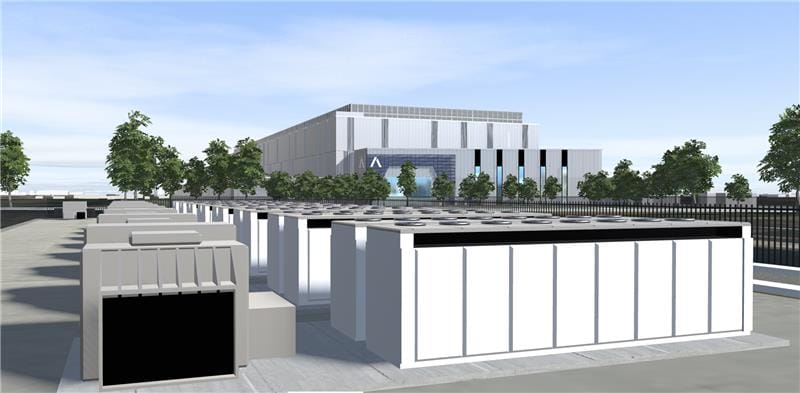
When grid constraints threatened to delay the delivery of our Hillsboro, OR data center, we pioneered a new path to solve the interconnection bottleneck instead of waiting years for grid upgrades. By partnering with the local utility, Portland General Electric (PGE), and on-site energy solutions provider, Calibrant Energy, we developed a Battery Energy Storage System (BESS) that will benefit both our customers and the local energy ecosystem.
A Catalyst for Innovation
Many major metropolitan areas are grappling with energy constraints. Hillsboro, the nation’s fifth-largest data center hub and a critical market for Aligned and our customers, was no exception.
For two decades, utilities like PGE saw growth that was slow and predictable, stemming mostly from steady population shifts and gradual electrification. Then, the way the world uses compute fundamentally shifted—we, the global population, moved beyond simple connected devices and began deploying technologies like AI modeling and inference at scale. This created a hockey stick inflection point in demand that our utilities and our industry hadn’t witnessed in twenty years.
We proactively dove deep into available technologies and engaged PGE to understand their specific challenge: critical peak demands—those few intense hours or days a year when the grid is absolutely pushed to the limit. Critical peak demands are not unique to Hillsboro; they are a common and growing problem for utilities across the entire United States. Peak power demand is projected to grow by 20% over the next decade, with new data center load alone expected to add as much as 100 GW by 20351.
Working closely with the PGE and Calibrant teams, we identified BESS as the optimal solution for this capacity bottleneck and engineered a first-of-its-kind solution to strategically integrate into the grid. In addition to prioritizing safety and the use of domestically manufactured components for this project, we also designed the BESS to be separate (yet synergistic) with our data center. The system will maximize energy consumption during off-peak times (when costs are lower and the grid is less stressed), store that energy, and then reduce its reliance on the grid during peak demand, effectively increasing the overall utilization and efficiency of existing grid infrastructure for the benefit of all users.
This approach also allowed us to guarantee our customers the same reliable solutions they expect from Aligned, while simultaneously providing PGE with a vital asset needed to serve us effectively and protect the wider local customer base.
Delivering a Grid Asset
The widely cited—yet misleading—idea that data centers are the sole driver of rising energy rates is a misconception that utilities across the country are working to dispel. Our BESS project is a great example of how data centers can be a powerful partner to the grid, uniquely positioned to help alleviate some of those pricing pressures.
The West Coast, for example, is experiencing a surge in electrification demand, driven not only by data centers and electrification—but also by our collective commitment to decarbonization. Replacing retired generation with variable resources like wind, solar, and batteries requires procuring significantly more capacity on a straight megawatt basis. This pursuit of new, lower carbon resources, combined with peak demand growth from factors like residential air conditioning and Electric Vehicle (EV) adoption in the Northwest, compounds the challenge. Ultimately, this multifaceted increase in electricity demand across the region translates directly to rising prices.
A recent study by the Lawrence Berkeley National Laboratory (LBNL) and The Brattle Group confirms that when significant load, such as large data centers, is added to the grid, these facilities become a robust anchor customer base that helps distribute the burden of fixed costs across a wider footprint. For instance, on the West Coast, where utilities face substantial fixed costs related to spend on wildfire liability and vegetation management, adding data centers does not create a 1:1 correlation in these non-variable expenses. However, as data centers add their load to the grid, every kilowatt-hour consumed bears a portion of these costs. This process—under the right conditions—allows the additional load to mitigate upward price pressure for all other customers.
A Paradigm Shift for Large Loads
The strategy required to bring data centers online has evolved, demanding increasing sophistication from operators. A decade ago, site selection focused on securing fiber and acreage. Today, escalating grid constraints and massive demand are forcing us to prioritize resource adequacy and available utility infrastructure. At Aligned, we recognize that being a responsible steward of this growth means being a proactive grid citizen.
Our BESS serves as a compelling example of what’s possible through early and collaborative engagement with utility partners. It serves as a blueprint for unlocking underutilized capacity across the U.S. A 2025 Duke University study found that enabling large energy users to reduce or shift load during periods of grid stress can facilitate faster integration of new capacity, potentially unlocking over 100 GW of power nationwide2.
Ultimately, this project demonstrates how our industry can successfully integrate the energy transition with unprecedented data center and AI load growth in a sustainable and growth-oriented manner that benefits all stakeholders.
- NERC, “2024 Long-Term Reliability Assessment”, updated July 2025. ↩︎
- Nicholas Institute for Energy, Environment & Sustainability, “Rethinking Load Growth: Assessing the Potential for Integration of Large Flexible Loads in US Power Systems”, published February 2025. ↩︎