How Closed Loop Data Center Cooling Works: Understanding the Process
Data centers power everyday life, from streaming and shopping to healthcare and education.
As they become more common, it’s natural for people to be curious about how they work, especially when it comes to resources like water.
A simple way to understand closed loop cooling is through something familiar.
Your car engine uses a closed cooling system, circulating coolant to absorb heat and reuse it, rather than constantly pulling in new fluid. Many laptops work the same way, moving heat away from components through a contained, recirculating system. Closed loop data center cooling follows this same principle, circulating fluid through a contained system to absorb and remove heat.
Let’s take a closer look at what closed loop cooling is and how it works.
What Is a Closed Loop Cooling System?
A closed loop cooling system continuously circulates water or coolant through a sealed system, allowing it to absorb heat, cool down, and be reused again and again.
Below provides a high-level snapshot of the closed loop cooling process and how heat is captured, transferred, and circulated within the system.
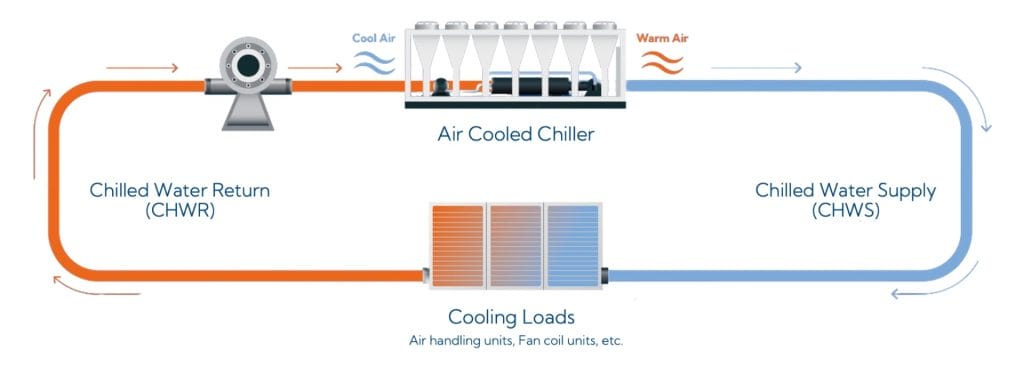
So, how does a closed loop cooling system work in practice? The process can be broken down into six simple steps.
Step 1: The Closed-Loop System is Filled
- Pure deionized (DI) water is used to fill the system
- Electrical heat trace is added to the system (no chemicals)
Step 2: Heat is Absorbed
- Chilled water circulates through cooling equipment, such as coils or heat exchangers
- The water absorbs heat from servers and electrical equipment
Step 3: Water Stays Inside the System
- The warmed water does not get discharged to sewer or surface water
- It stays within sealed piping and equipment
Step 4: Heat is Rejected
- The heat is removed from the water using air-cooled chillers via heat exchangers
- No evaporative cooling towers are required in waterless or low-water designs
Step 5: Water is Reused
- The same water is cooled again and sent back through the loop
- This cycle repeats continuously
- No continuous wastewater discharge
Step 6: Minimal Water Loss
- Water loss is limited to strainer cleaning once every quarter
- Each strainer’s water loss averages around 2-5 gallons
For a quick visual explanation, watch our closed-loop cooling video.
Our Commitment to Responsible Water Stewardship
Our investment in closed loop cooling for data centers is part of a larger commitment to environmental responsibility and resource stewardship.
We recognize that water is a vital community resource, and we are dedicated to protecting local water supplies through efficient design, responsible operations, and sustainable infrastructure choices.
By integrating water-conscious cooling solutions into our data centers, we are helping build a future where innovation and environmental stewardship go hand in hand.
Frequently Asked Questions
What is Water Usage Effectiveness (WUE) in data centers?
Water Usage Effectiveness (WUE) is a standard sustainability metric calculated by dividing annual facility water consumption by the energy consumed by IT equipment. Traditional data centers can have high WUE scores due to evaporative cooling towers. Modern facilities utilizing closed-loop systems and air-cooled chillers achieve a WUE of zero for heat rejection, using zero gallons of water per kilowatt-hour for cooling operations.
Is water discharged into local sewer or storm systems from closed-loop data centers?
No, closed-loop cooling systems do not produce continuous wastewater or discharge cooling water into municipal sewer or surface water systems. Water loss is minimal, restricted almost entirely to routine quarterly strainer maintenance that yields only about 2 to 5 gallons per strainer.
What is the difference between open cooling towers and closed-loop cooling in data centers?
Open cooling towers cool equipment by spraying municipal water over a fill material, allowing a large portion of the water to evaporate into the atmosphere (creating visible steam plumes) and requiring constant water replenishment. Closed-loop cooling seals pure water inside internal piping. The internal water continually recirculates to move heat to external air-cooled chillers, keeping water consumption virtually at zero.